
How to Create Topic Clusters with AI (Complete Guide + Free Tools)
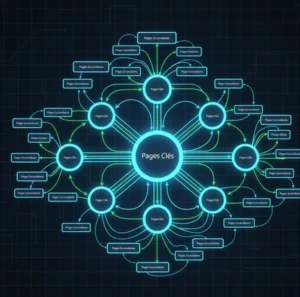
- An AI-driven topic cluster relies on a pillar page linked to cluster pages and sub-cluster pages that explore a single topic in depth.
- Tools like ChatGPT, Cuik, or NeuronWriter can generate a content hierarchy in minutes, often with free versions.
- The quality of internal linking is as important as content volume: every link must have a clear semantic purpose.
- AI accelerates keyword research and structuring, but the final copy always requires a human editorial review.
- Poorly linked or overly generic clusters can lead to keyword cannibalization, hurting your rankings.
Creating a topic cluster (or “semantic cocoon”) with AI involves structuring a group of web pages around a central theme—the pillar page—linked to cluster and sub-cluster pages that each address a specific sub-topic. The goal is to signal to search engines that your site is a topical authority on a subject, rather than just publishing isolated articles.
AI intervenes at several stages: keyword research, hierarchy generation, detailed brief creation, and sometimes content production. Solutions like ChatGPT, Cuik, or NeuronWriter allow you to build an initial framework in minutes, including free options, without replacing the core editorial work. This guide details the seven-step method, the tools available on a budget, and the pitfalls that can turn a promising cluster into an SEO nightmare.
What is a Topic Cluster and How AI Changes the Game
A topic cluster is a content architecture that organizes a site around a central theme via a page hierarchy: a general pillar page, cluster pages that dive into sub-themes, and occasionally sub-cluster pages for highly specific technical details. Unlike a traditional SEO silo—where sections are strictly isolated—a topic cluster allows “link juice” to flow within a thematic group, provided that every link remains semantically relevant.
Two technical concepts drive this method: semantic proximity, which measures if two pages actually treat neighboring topics, and semantic drift, which ensures the hierarchy progresses in a coherent direction rather than scattering. Historically, building a cluster required hours of manual keyword research, brainstorming, and mapping using mind-mapping tools like XMind or MindMeister.
Generative AI is a game-changer in three ways. First, it accelerates ideation: a model like ChatGPT can list dozens of sub-themes, recurring user questions, and unique angles from a single keyword in seconds. Second, it structures: specialized tools like SurferSEO or NeuronWriter provide optimized hierarchy schemes based on a target keyword. Finally, it documents the editorial brief, generating precise instructions (lexical field, length, questions to answer) that can be passed to a writer or another AI agent. The result isn’t a finished cluster—human validation is still required—but a functional foundation that would have taken days to build manually.
Step 1 — Define the Central Theme and Pillar Page
Before diving into keywords, you must define the cluster’s scope: a theme broad enough to justify 10 to 50 pages, but narrow enough to maintain focus. A cluster on “digital marketing” is too broad; a cluster on “B2B SaaS email marketing” is actionable. The pillar page—which will receive the most internal links and target the most competitive keyword—should satisfy the general search intent of the topic while introducing the sub-themes developed elsewhere in the cluster.
This is where AI is most helpful early on: asking an LLM to list the primary questions users have about a topic helps quickly identify the pillar page’s axes and anticipate the necessary cluster pages. However, stay vigilant: AI models often suggest generic angles. Manual curation is essential to keep the angles that align with your specific positioning, audience, and product.
A best practice is to cross-reference this initial list with existing search data (Google Search Console, search volumes, forum discussions, or industry-specific social media) to ensure the theme meets real demand rather than just an intuition. This framing stage is critical: a cluster built on a vague theme will produce redundant cluster pages, leading to future cannibalization.
Step 2 — AI-Assisted Keyword Research
Keyword research remains the most technical part of the process, where free AI tools offer a significant advantage over manual brainstorming. The principle: start with the pillar page’s primary keyword, then generate variants, associated questions, and long-tail keywords that will become potential cluster pages.
Tools like ChatGPT or Neuroflash can quickly generate lists of related topics based on a simple prompt describing the theme and target audience. The advantage: it surfaces angles a human writer might overlook, especially in niche areas. The limitation: these tools do not measure actual search volume or ranking difficulty. Dedicated solutions like SEMrush or Google Keyword Planner remain necessary to prioritize keywords by traffic potential.
The ideal workflow combines both: use generative AI for exhaustiveness (listing as many angles as possible) and a data tool for prioritization (selecting those with viable volume and manageable competition). Once the list is ready, group keywords by search intent—informational, comparative, transactional—as each group corresponds to a different page type in the hierarchy: deep-dive articles for informational, comparisons for transactional, and practical guides for mixed intent.
Step 3 — Building the Hierarchy with AI
Once keywords are grouped, organize them hierarchically: pillar page $\rightarrow$ cluster pages $\rightarrow$ sub-cluster pages for technical topics. This is where specialized tools outperform general LLMs. For example, Cuik offers a free topic cluster generator that automatically produces a two-level structure from a single keyword, visualized as an interactive mind map—a fast way to start an AI cluster for free.
Other tools like SurferSEO or NeuronWriter go further by suggesting detailed content schemes for each page, including suggested subheadings and the lexical field to cover. While these are paid beyond limited use, they are invaluable for validating the overall coherence of a cluster before starting production.
The hierarchy must follow one simple rule: every cluster page must provide information that the pillar page does not cover in detail, without straying from the main subject’s lexical field. An effective cluster avoids two opposite pitfalls: redundancy (multiple pages answering the same question under different titles) and dispersion (a cluster page straying so far it deserves its own independent cluster). Visualizing the full map before writing helps spot these issues before they waste editorial time.
Step 4 — Generating Content Briefs with AI
Once the hierarchy is validated, every page needs a precise editorial brief: target keyword, search intent, heading structure (H1, H2, H3), indicative length, questions to cover, and the expected semantic field. Generative AI excels here because it involves structuring already-collected information rather than creating original content from scratch.
In practice, a well-crafted prompt—describing the topic, audience, the page’s position in the cluster (pillar, cluster, or sub-cluster), and associated keywords—can produce a detailed outline in seconds. The benefit isn’t just speed; it ensures structural consistency across the cluster, which simplifies internal linking since each brief can explicitly state which other cluster pages should be linked.
This brief should then be handed over to a human writer or a second AI generation pass dedicated to drafting. Separating the structuring phase (brief) from the writing phase (content) avoids a common mistake: articles that all follow the same phrasing patterns because they were generated in one block by the same model without human intervention on the outline.
Step 5 — Writing Without Sacrificing Quality
Writing is the stage where AI requires the most oversight. Generating an entire article from a single prompt usually results in text that is grammatically correct but generic: few concrete examples, lack of nuance, and a tone that sounds like every other site in the niche. For a topic cluster, this is a major flaw because the goal—demonstrating deep expertise—requires differentiated content from page to page.
The winning method is to use AI for the first draft, then enrich it with elements the model cannot reliably invent: verified data, case studies, personal experience, and specific use cases for your audience. A cluster article that merely paraphrases generalities found on dozens of other sites provides no added value to search engines, regardless of how well it is linked.
You must also ensure terminological consistency: if the pillar page uses a specific term for a concept, the cluster pages should use that same terminology rather than random synonyms generated by the AI. This shared lexical field reinforces the thematic coherence of the cluster in the eyes of search engines.
Step 6 — Constructing Relevant Internal Linking
Internal linking is what transforms a collection of pages into a true topic cluster. Every cluster page should point back to the pillar page with explicit anchor text, and the pillar page should link to all its cluster pages. Between cluster pages treating neighboring topics, cross-links further strengthen thematic coherence, provided they are justified by the content and not added artificially to inflate link counts.
The golden rule: an internal link only has semantic value if it fits naturally into a sentence where the target page’s subject is actually being discussed. Links added at the end of an article in a “See Also” list provide far less value than links integrated into the narrative flow. Tools like Yourtext.Guru or Visibilis analyze semantic proximity to identify missing links or poorly connected pages.
A common error is over-linking to the pillar page while neglecting horizontal links between related cluster pages. This creates a flat “star” structure, which is less effective than a multi-level hierarchy where authority flows both vertically and horizontally. Planning this linking strategy during the brief phase prevents the need to rewrite articles after publication.
Step 7 — Auditing, Measuring, and Updating the Cluster
A topic cluster is never “finished.” Page performance evolves, new user questions emerge, and competitors publish new content. Regular audits allow you to verify three things: internal linking coherence, ranking/traffic performance for each page, and the absence of keyword cannibalization.
Technically, a tool like SEMrush can audit a site’s internal link score and identify “deep pages”—those requiring more than three clicks from the homepage—which often correlates with poorer rankings. Specialized tools like cocon.se can visualize site architecture to spot linking errors visually.
Editorially, monitor whether two pages in the cluster are ranking for the same queries; this is a sign of cannibalization. Resolve this by either merging the two pages or clearly redefining their respective search intents. Finally, pillar pages, which concentrate the most traffic and links, should be updated at least annually to stay aligned with the topic’s evolution—a process AI can assist with by comparing existing content to new search trends.
Free Tools to Create Topic Clusters with AI
You don’t need a premium subscription to start. Several free tools cover the process: – Cuik: Offers a free topic cluster generator that creates a two-level structure and a mind map visualization. – ChatGPT (Free version): The most versatile tool for ideation, brief generation, and outline structuring. – Mind-mapping tools: Free versions of XMind, Freemind, or Wisemapping help materialize the pillar/cluster/sub-cluster hierarchy. – Google Keyword Planner: Free with a Google Ads account, it provides the actual search volume data that generative AI lacks.
The limits of free tools are mostly around volume (rate limits on queries) and advanced analysis (automated semantic proximity audits). For a first cluster or a test on a new site, the combination of a free generator like Cuik, ChatGPT for briefs, and a mind-map tool is more than sufficient.
Common Mistakes to Avoid with AI-Generated Clusters
The first mistake is publishing an AI-generated plan without cross-referencing it with real audience data. AI produces plausible angles, not necessarily the ones your users are searching for. Always validate AI suggestions with Google Search Console or customer feedback.
The second mistake is cannibalization: generating too many cluster pages that are too similar, targeting variants of the same keyword without a distinct difference in search intent. AI tends to multiply similar angles because it doesn’t instinctively know where the boundary between two distinct topics lies—this requires human judgment.
The third mistake is neglecting internal linking in favor of content volume. A thirty-page cluster without coherent links is just a collection of isolated articles. Finally, avoid “tonal monotony.” Generating all pages with the same prompt results in stylistically identical text. Vary your formats (deep dives, comparisons, Q&As) within the same cluster to limit this effect and better cover different search intents.
How can I create a topic cluster for free using AI?
By combining a free generator like Cuik for the hierarchy, ChatGPT for briefs and related topics, and a free mind-mapping tool like Freemind to visualize the structure before writing.
What is the difference between a topic cluster and an SEO silo?
An SEO silo enforces total isolation between thematic sections with no cross-links. A topic cluster allows links between closely related pages within the same group, provided the semantic proximity is strong, allowing for a more nuanced flow of SEO equity.
How many pages are needed for a topic cluster?
There is no fixed number, but results generally become visible starting from about ten well-linked pages around a pillar page, potentially growing to dozens depending on the theme’s breadth.
Can AI write the cluster articles on its own?
It can produce a first draft or structure, but content generated without human enrichment (real-world examples, verified data, actual expertise) remains generic and will struggle to differentiate itself from other pages on the web.
Which AI tools are best for topic cluster keyword research?
ChatGPT or Neuroflash for listing angles and related topics, supplemented by data tools like SEMrush or Google Keyword Planner to verify volume and prioritize the most relevant keywords.
How do I avoid SEO cannibalization in a topic cluster?
By defining a unique and distinct search intent for every page during the brief phase and regularly monitoring if multiple pages are ranking for the same queries.
Which free tool visualizes a topic cluster hierarchy?
Cuik provides a mind map visualization directly linked to its free generator; generic tools like XMind, Freemind, or Wisemapping also allow you to manually map the pillar/cluster/sub-cluster hierarchy.
Sources
- Digitcave — Creating a topic cluster with AI
- Easyhoster — Topic cluster briefs for AI agents
- Cuik — Free topic cluster generator
- Semji — Siloing and semantic cocoons
- Semji — Complete guide to semantic cocoons
- Ineolab — What is a semantic cocoon
- HubSpot — Semantic cocoons and topic clusters
- JetOctopus — SEO Silos